


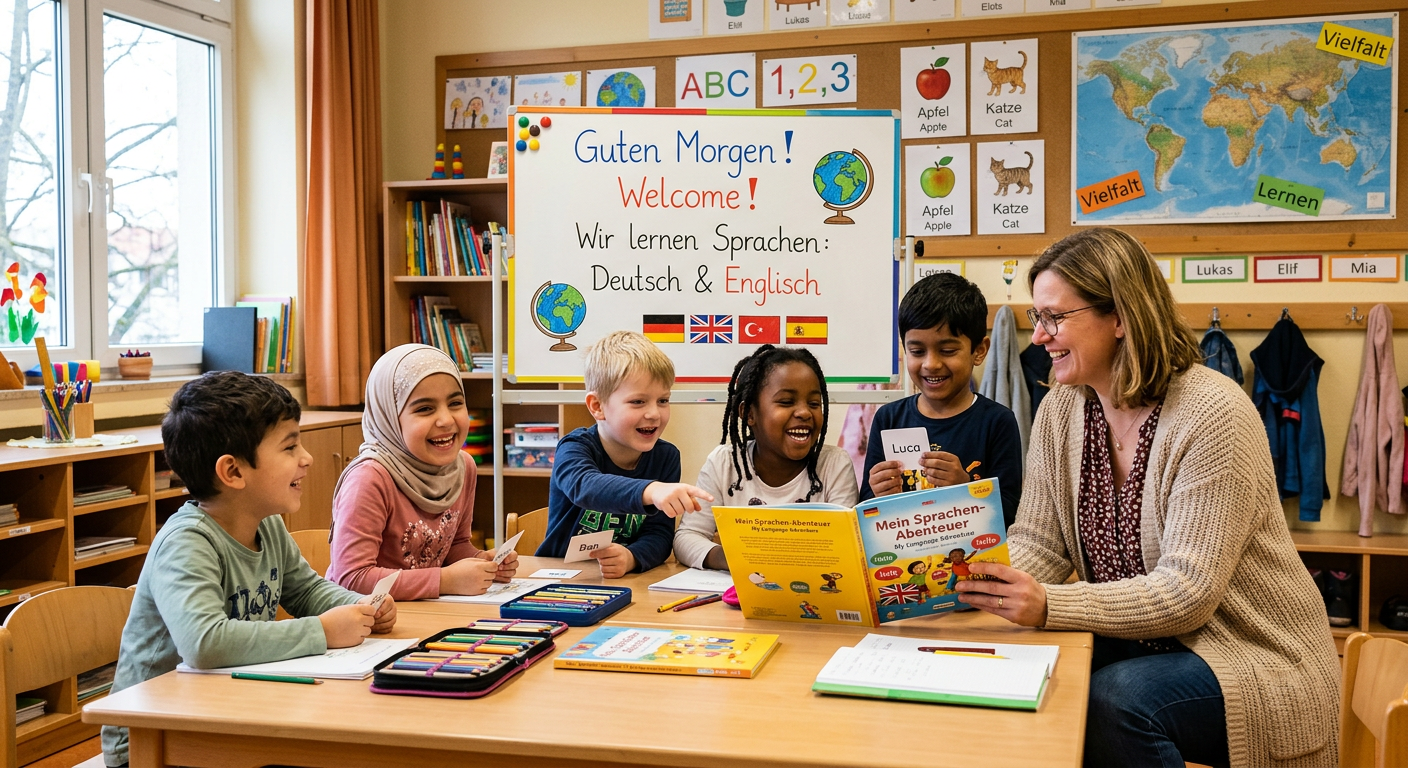
Bilingual Children 2026: When and How to Start Best?
Bilingual children benefit throughout their lives from their language skills, in school, in their careers, and in social life. But when is the best time to start with a second language, and how to do it most effectively? Science gives clear answers, and for parents in Germany, especially in regions like the Harz with many immigrant families, these insights are particularly valuable.
What Science Says About Bilingualism
Numerous studies confirm that the human brain is especially receptive to languages in the first years of life. Children under seven learn languages almost effortlessly because their neural connections are still very plastic. This so-called sensitive period (also called the critical period) ends around puberty. After that, language learning is still possible but requires more conscious effort.
Important: bilingualism does not harm language development. For a long time it was feared that children learning two languages simultaneously would perform worse in both. Current research clearly refutes this. Children may initially mix words from both languages (code-switching), but this is a normal and temporary developmental step.
The OPOL Method: One Person, One Language
One of the most successful strategies for bilingual families is the OPOL principle: One Parent, One Language. Each parent consistently speaks their mother tongue with the child. The child learns both languages in a natural context without artificial switching. This model works especially well when both parents remain consistent, even when the child initially prefers the more understandable language.
Tips for Parents in Germany with a Migration Background
For families who have moved to Germany and want to preserve their heritage language while their children also learn German, here are some practical recommendations:
- Speak your mother tongue at home, but let your child also hear and speak plenty of German (daycare, friends, media).
- Read regularly in both languages. Books and stories develop vocabulary in both languages simultaneously.
- Turn on German children’s programs: ARD Mediathek and KiKA offer age-appropriate content.
- Support your child with language difficulties at school early with targeted help.
From What Age Should German Start?
Ideally from birth if German is the surrounding language or a parent speaks German. For children who arrive in Germany later: the earlier the better, but older children also learn quickly when immersed in a German-speaking environment and actively supported.
Primary school children (ages 6-10) particularly benefit from structured support in small groups. A targeted German course can help close gaps and consolidate school language skills. J.T.Com Language School offers courses for children and young people. Information on current times is in the course schedule.
Bilingualism and Academic Success
Bilingual children often show stronger cognitive flexibility: they switch between tasks more easily, solve problems more creatively, and have better working memory. These abilities extend well beyond language and support general academic success.
Common Mistakes in Bilingual Upbringing
Some parents, worried about language confusion, make a counterproductive mistake: they speak only German with their children even though their own German competence is limited. Children then learn neither proper German nor maintain their mother tongue. Better to keep the mother tongue strong and promote German through school and everyday life.
FAQ: Bilingual Children
Does bilingualism harm language development?
No. Current research shows bilingualism has no negative effects on language development. Short-term phenomena like code-switching are normal and temporary.
From what age is it too late to learn a second language?
It is never too late. But the earlier you start, the more naturally and effortlessly learning happens. Children before puberty learn languages fastest and with less accent.
What is the OPOL method?
OPOL stands for “One Parent, One Language”. Each parent consistently speaks their mother tongue with the child. This is one of the most successful strategies for bilingual families.
How can I support my child in learning German?
Integrate German into daily life: read German books, watch German children’s programs, encourage contact with German-speaking playmates. For structured support, a course at J.T.Com Language School in Clausthal-Zellerfeld is recommended.
What advantages do bilingual children have later in life?
Bilingual children have better career prospects, stronger cognitive abilities, greater empathy, and a better understanding of different cultures. These advantages positively impact school, university, and professional life.
Want to actively support your child in learning German? J.T.Com Language School, Silberstrasse 5, Clausthal-Zellerfeld, offers age-appropriate German courses for children and teenagers in small groups. Check the course schedule and Prices and Dates.