

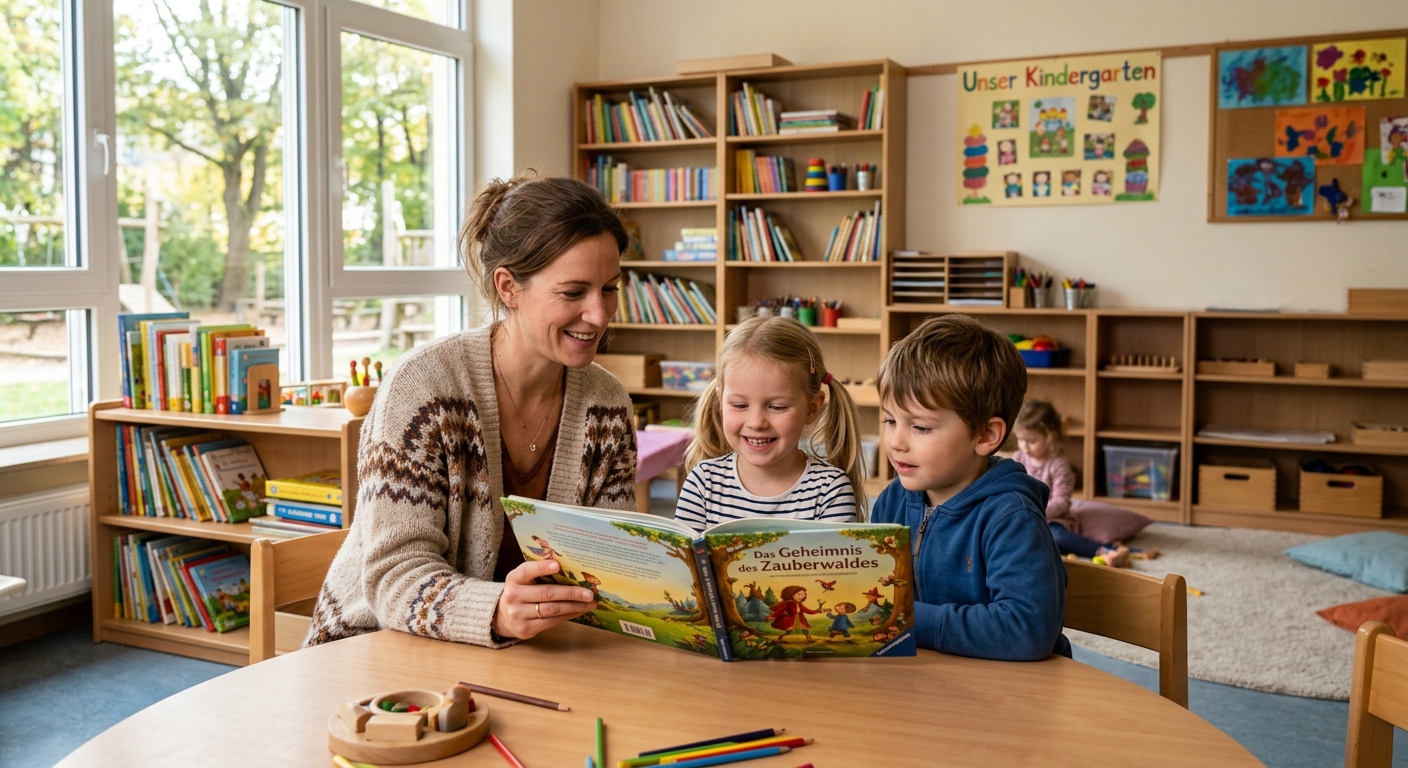
Germany is home to more than 700,000 qualified early childhood educators working in daycare centres, kindergartens, and nurseries. Among them is a growing number of international professionals who have relocated from abroad and are now building careers in the German childcare sector. For these educators, German language proficiency — and in particular, the professional vocabulary of early childhood education — presents one of the most significant challenges. This article explains what language skills early childhood educators need in Germany and how a targeted German course can support both professional entry and long-term career development.
Why Language Skills Are Essential for Early Childhood Educators
Working in a childcare setting without solid German language skills is barely conceivable. Educators communicate daily with children, parents, colleagues, and institutional representatives. This involves far more than everyday conversation — it requires writing developmental reports, conducting parent meetings, completing observational assessments, and explaining educational concepts with precision and confidence.
International professionals who wish to work as an educator in Germany are generally required to provide proof of German language proficiency at B2 level. In many German states, C1 level is additionally required when applying for official recognition of foreign educational qualifications. These language requirements are not bureaucratic obstacles — they are quality standards, because language is an educator’s most important professional tool.
Comparable demands exist in other care professions. Our article on the German course for nursing staff covers the language requirements in the healthcare sector in detail.
Which Language Situations Do Educators Face on a Daily Basis?
The working day of an early childhood educator is language-intensive. International professionals encounter a wide range of communicative situations that require linguistic confidence and precision:
Parent meetings: Regular developmental conversations with parents require empathy and clear communication. Educators need to describe a child’s development, share their own observations, and sensitively raise difficult topics — such as developmental delays or behavioural patterns of concern. Misunderstandings in these conversations can damage parental trust significantly and affect the family-educator relationship.
Documentation and reports: Written documentation of child development is a core element of professional practice in German childcare settings. Portfolio entries, developmental assessments, handover documentation, and progress reports must be linguistically accurate and professionally precise. Uncertainty in this area costs valuable time and may expose staff to criticism.
Team communication: Team meetings involve discussing educational frameworks, sharing observations, and planning activities and responses. Educators who cannot actively participate in these discussions are quickly marginalised and are unable to contribute their professional expertise — with direct consequences for their standing within the team and their career prospects.
Communicating with children: The language educators use with children has a direct impact on the children’s own language development. Children absorb language from the adults around them. Grammatically correct and expressive speech is therefore especially important in this professional context.
Administrative communication: Submitting applications, completing official forms, corresponding with government offices and social services — these tasks are also part of everyday professional life, particularly for educators in supervisory or management roles.
What Level of German Do Early Childhood Educators Need in Germany?
Requirements vary depending on the German state and the individual employer, but the general benchmarks are as follows:
- B1 level: Sometimes sufficient for basic childcare support roles, but generally too low for a fully qualified educator position with independent group leadership responsibilities.
- B2 level: The minimum requirement for most childcare providers and employers. At this level, professionals can hold complex conversations and read and write professionally structured texts. Many German states require B2 as a fundamental prerequisite for recognition of foreign qualifications.
- C1 level: Recommended or required for formal recognition of foreign educational qualifications by state authorities. C1 enables fluent and precise communication even in demanding professional situations, without meaningful linguistic limitations.
Crucially, it is not only the general language level that matters — it is specifically the command of professional educational vocabulary. Someone who speaks fluent German but does not know terms such as „Inklusion“, „Transition“, „Bildungsplan“, or „Kompetenzorientierung“ will quickly encounter limitations in the professional environment. To understand how long it realistically takes to reach the required level, read our article on realistic time planning for learning German.
Key Professional Terms for Early Childhood Educators
Educators working in Germany should be able to use the following concepts confidently. These terms are not simply technical vocabulary — they form the language of professional practice and are central to building trust with parents, colleagues, and institutional partners:
- Educational domains: Language and communication, nature and environment, movement, arts and creativity, social and emotional competence
- Observation and documentation: Portfolio work, developmental conversations, learning stories, observational screening tools (e.g. SISMIK, SELDAK, developmental milestones)
- Inclusion and participation: Individual support plan (Förderplan), specialised support, reasonable adjustments, compensatory measures
- Settling-in process: Berlin model, Munich model, transitional support planning, attachment figure (Bindungsperson)
- Teamwork: Case discussions, professional supervision, peer consultation, shift and duty planning
- Parent involvement: Parents‘ evening, parents‘ council, educational partnership, initial intake meeting
Mastery of this vocabulary signals professional competence. Parents, employers, and colleagues notice when an educator speaks with precision and confidence about their work — and it matters for career development.
How to Prepare Linguistically for a Career as an Early Childhood Educator
A targeted German course for education professionals is the most effective way to develop the language skills the role demands. Unlike a general language course, a vocationally oriented programme addresses the specific communication challenges of the professional environment directly and practically. A high-quality course should include the following elements:
Core German language skills: Grammar, pronunciation, and writing competence are the essential foundation. Without these, no specialist course can deliver lasting results.
Professional vocabulary: Educational terminology, standard formulations for developmental reports, parent meetings, and team discussions need to be practised and internalised through repeated use.
Spoken practice: Role plays for challenging parent conversations, team presentations, and discussions about pedagogical concepts — situations that occur daily in the workplace and require linguistic confidence under pressure.
Writing exercises: Drafting structured developmental reports, composing professional emails to parents, and writing observational notes — with individual feedback on language quality, style, and accuracy.
Exam preparation: If a telc certificate at B2 or C1 level is required, a quality course prepares participants systematically for the exam format — using authentic practice tasks, time management strategies, and targeted individual coaching.
Consistency matters too: language skills grow through regular application. Educators who are already working in childcare benefit particularly from a course that directly addresses the language demands of their working life, allowing them to apply new skills immediately in a real professional context.
German Courses for Early Childhood Educators at J.T.Com in Clausthal-Zellerfeld
J.T.Com Language School at Silberstraße 5, 38678 Clausthal-Zellerfeld offers tailored German courses for international professionals — including programmes specifically designed for those working in education and childcare. Whether individual tuition or small group learning, in-person or online: our experienced team develops a course programme matched to your individual language needs and the specific demands of your professional context.
We prepare you for the real-world language situations of working in a Kita — from parent communication and written documentation to systematic preparation for the telc B2 or C1 certificate. Our courses are taught in small groups, ensuring every participant receives sufficient individual attention and meaningful feedback throughout the learning process.
Reach out to us via our contact form to learn more about our course offerings and to arrange a free initial consultation.
FAQ: German for Early Childhood Educators 2026
What level of German do I need to work in a German kindergarten or Kita?
B2 level is generally the minimum requirement expected by most childcare employers. For the formal recognition of foreign educational qualifications, many German states require C1 level. Exact requirements vary by state — we recommend contacting the relevant recognition advisory service in your area for specific guidance.
What is professional educational language and why does it matter?
Professional educational language encompasses all the terminology, phrasing, and communicative conventions used in early childhood education and care. It matters because it enables effective professional communication with parents, colleagues, and institutions, and makes your expertise visible to the people around you. Educators who use this language confidently are perceived as more competent and trustworthy.
Can I take a German course while I am already working in a Kita?
Yes — and it is highly recommended. A course that directly addresses the language situations of your working life helps you apply new skills immediately in practice. Many childcare providers actively support their staff in continuing language development — it is worth asking your employer about available support options or funding.
Does J.T.Com offer telc exam preparation courses for early childhood educators?
Yes. J.T.Com Language School prepares participants for telc exams at B1, B2, and C1 levels. Our preparation courses use authentic texts from educational contexts, structured practice tasks aligned with the exam format, and individual coaching throughout the preparation process.
How long does it take to reach the language level required for an educator role in Germany?
This depends on your current starting level and the intensity of your study. Learners who already communicate at A2 or B1 level can typically reach B2 within six to twelve months of focused language study. Reaching C1 may require a further six to twelve months. Regular practice and direct application of German in your working environment significantly accelerates overall progress.