


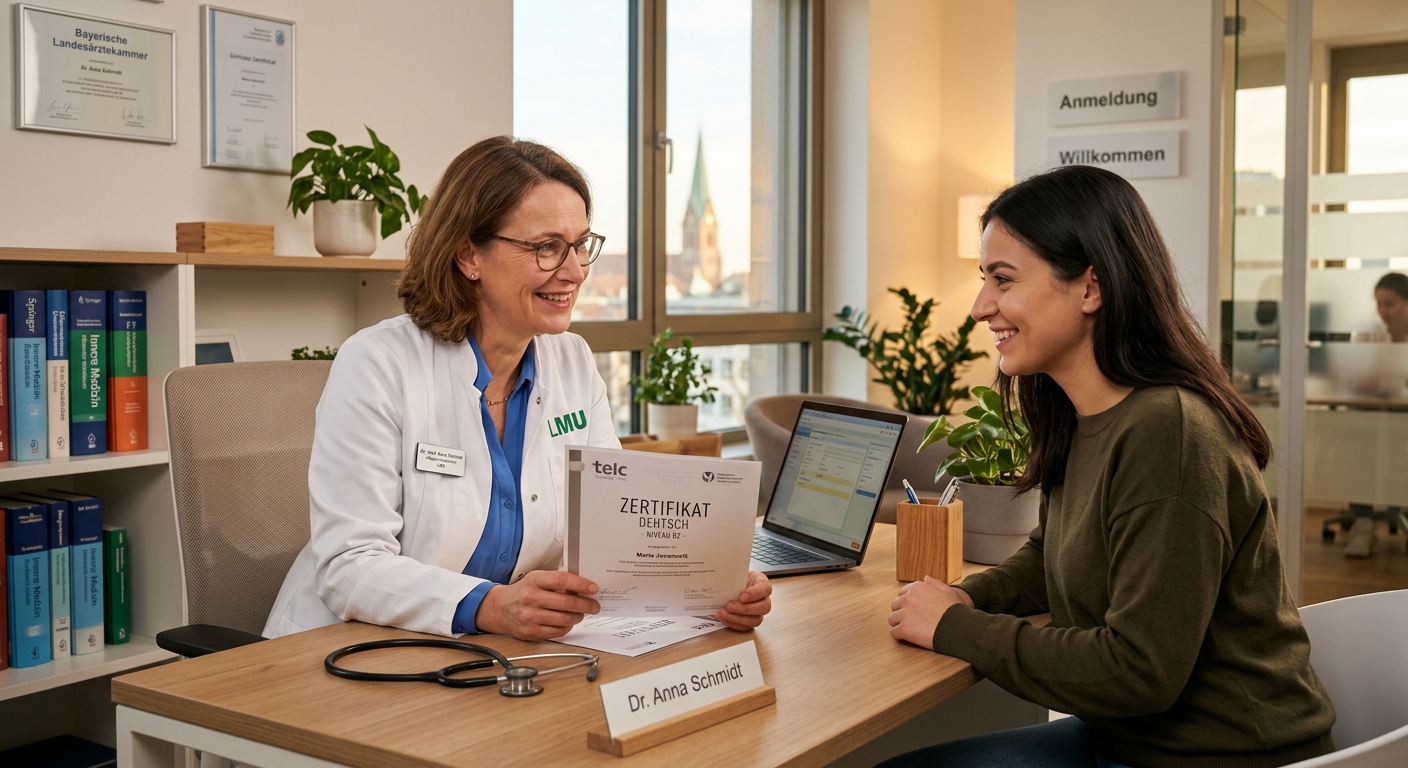
Doctors trained abroad who wish to work in Germany face an important requirement: the Fachsprachenpruefung (medical language examination). This examination is a prerequisite in most German federal states, including Lower Saxony, for obtaining medical licensure (Approbation) or a temporary work permit. If you want to practice medicine in Germany, you need not only clinical expertise but also a high level of German language proficiency. In Lower Saxony, the medical language examination is administered by the Niedersaechsisches Landesgesundheitsamt (NLGA). While this may sound daunting, it is entirely achievable with the right preparation.
In this article, you will learn everything you need to know about the medical language examination for doctors in Lower Saxony: what language level is required, how the exam works, and how to prepare most effectively. J.T.Com Language School in Clausthal-Zellerfeld supports internationally trained physicians with targeted German language courses designed for medical professionals.
What Is the Fachsprachenpruefung for Doctors in Germany?
The Fachsprachenpruefung (FSP) is a language examination specifically designed for the medical field. Unlike general German certificates such as telc exams or the Goethe-Zertifikat, the FSP tests your ability to communicate effectively in real clinical situations. The exam typically consists of three parts:
- Patient consultation (anamnesis interview): An examiner plays the role of a patient. You take the patient history and explain the next diagnostic steps.
- Written documentation: Based on the patient consultation, you produce a medical report or referral letter in written German.
- Colleague or nursing staff dialogue: Simulation of a professional interaction, such as a clinical handover or consultation.
Examiners assess not only grammar and vocabulary but, above all, your ability to communicate medical information clearly and appropriately for different audiences.
What Level of German Do Doctors Need?
The official requirement is typically C1 level on the Common European Framework of Reference (CEFR). However, the medical language examination goes beyond a standard C1 certificate in terms of content, as it presupposes specific medical communication competencies. A general C1 level provides an excellent foundation, but doctors must also develop domain-specific vocabulary and become familiar with the communication formats used in the German healthcare system.
Areas that are particularly challenging include:
- Medical terminology and its German equivalents
- Patient-friendly language (explaining complex matters to laypeople)
- Written documentation following German clinical standards
- Understanding rapid, informal speech under pressure
A good general German level alone is not enough. Targeted preparation for medical communication scenarios is essential. Browse our current German course schedule to find a suitable programme.
How Does the Fachsprachenpruefung Work in Lower Saxony?
In Lower Saxony, the NLGA (Niedersaechsisches Landesgesundheitsamt) administers the Fachsprachenpruefung. The process is as follows:
- Application: You submit your application for Approbation or a temporary medical licence to the competent authority. As part of this process, you will be invited to take the FSP if your general language competence has not yet been demonstrated through a recognised certificate.
- Scheduling: The NLGA assigns examination dates. Waiting times can vary depending on demand, so early registration is strongly recommended.
- The examination: The exam typically takes place at NLGA premises or partner institutions and lasts between 60 and 90 minutes depending on the format.
- Results: Results are usually communicated within a few weeks after the examination. If you do not pass, a resit is possible.
Important: The Fachsprachenpruefung is not a state-issued language certificate; it is a professional language assessment. It is recognised exclusively for the purpose of medical licensure.
Common Mistakes and Challenges in Preparation
Many internationally trained doctors underestimate the preparation effort required. Here are the most common pitfalls:
1. Focusing only on grammar: The exam assesses communication, not perfect grammar. Those who spend all their time on grammar exercises neglect the speaking practice they need most.
2. Too little spoken practice: Medical conversations need to be trained under time pressure and in roleplay scenarios. Learning exclusively from textbooks is insufficient.
3. Unfamiliarity with the German hospital environment: Terms like "Uebergabe" (handover), "Visite" (ward round), "Arztbrief" (discharge letter), or "Konsil" (consultation) are very specific to the German healthcare context. Not knowing these structures will cause difficulties in the exam.
4. Insufficient writing practice: Medical reports and documentation in Germany follow a specific format that must be learned and practised.
A dedicated preparation course at J.T.Com Language School addresses all of these areas systematically. Find out more about our prices and course dates now.
How to Prepare Effectively for the Medical Language Examination
Successful preparation requires time and structure. We recommend the following approach:
Step 1 – Self-assessment: Honestly evaluate your current German level. If you are not yet at B2/C1, begin with an intensive German course. If you are already at C1 level, you can move straight to medical language training.
Step 2 – Build medical vocabulary: Work with medical dictionaries and authentic German discharge letters. Learn the German equivalents for symptoms, diagnoses, and treatments.
Step 3 – Practise anamnesis interviews: Find a practice partner or join a course that simulates roleplay situations. The ability to systematically conduct a patient history interview must become second nature.
Step 4 – Write medical reports: Regularly write discharge letters based on concrete clinical cases. Have these corrected by a native speaker or language teacher.
Step 5 – Mock examinations: Take part in practice exams that simulate the real examination format. This reduces exam stress and reveals remaining gaps in your knowledge.
J.T.Com Language School in Clausthal-Zellerfeld offers individual tuition and small group courses tailored to these requirements. Our experienced teachers know the typical exam formats and will prepare you strategically.
From the Language Examination to Full Approbation: Next Steps
Passing the Fachsprachenpruefung is an important milestone, but not the final step on the road to Approbation. In Lower Saxony, the following additional documents are typically required:
- Recognition decision for your foreign medical degree
- Evidence of clinical experience (a temporary work permit may be available as an interim solution)
- Police clearance certificate and certificate of good health
- Documentation of qualifications from your country of origin
The exact requirements vary depending on your country of origin and individual circumstances. The responsible recognition authority in Lower Saxony will advise you in detail on your specific case.
Language is the foundation: without sufficient German proficiency, Approbation cannot be granted. This makes early and targeted language preparation all the more important.
By the way: if you are interested in learning other languages alongside German, J.T.Com has you covered. We also offer Spanish courses for professional and everyday contexts.
Frequently Asked Questions about the Medical Language Examination (FAQ)
Do I still need the Fachsprachenpruefung if I already hold a C1 certificate?
This depends on the competent authority. In Lower Saxony, a separate medical language examination is often required even if you hold a general C1 certificate, because the FSP specifically assesses medical communication competence. Clarify this directly with the NLGA or the relevant recognition authority.
How long do I need to prepare?
This depends heavily on your current language level. Those who are already at B2 can typically reach examination readiness within three to six months of intensive preparation. Starting from A2 or B1 level, a year or more should be expected.
Can I retake the examination if I fail?
Yes, a resit of the Fachsprachenpruefung is possible in Lower Saxony. The specific rules regarding waiting periods and maximum attempts can be obtained from the NLGA.
Does J.T.Com Language School offer specialised courses for doctors?
Yes. We offer individual tuition and small-group courses with a focus on medical communication, anamnesis interviews, discharge letter writing, and examination preparation. Courses are structured around your individual needs and schedule.
Is online tuition available for medical language preparation?
Yes, we offer online lessons as well. Particularly for doctors who are already working or live far away, remote learning is a flexible and effective solution. Core exam skills such as reading and writing can be trained very effectively online. Oral examination scenarios can be simulated via video call.
Start Your Language Preparation Today
The path to medical Approbation in Lower Saxony requires solid German language skills and dedicated preparation for the Fachsprachenpruefung. J.T.Com Language School in Clausthal-Zellerfeld supports you with individual courses, experienced teachers, and practice-focused instruction.
Take the first step today and arrange a no-obligation initial consultation. Check our current prices and course dates or write to us directly. We look forward to accompanying you on your professional journey in Germany.