


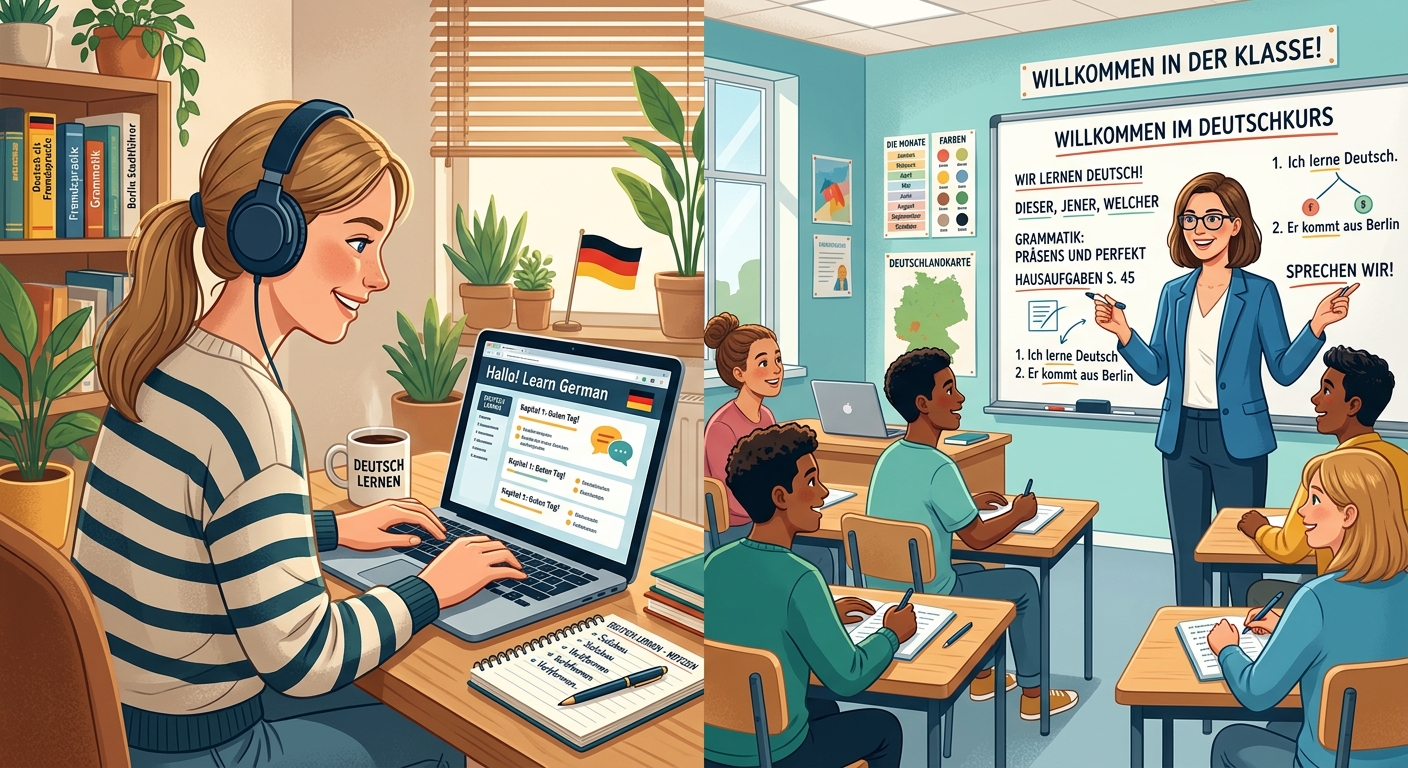
Online German courses are everywhere in 2026 — but are they actually better than traditional classroom learning? This is a question many people face when starting their German language journey or thinking about switching formats. The honest answer: it depends. On your goals, your daily routine, and — crucially — how you learn best as an individual. This article compares both formats fairly so you can make an informed decision.
One thing upfront: J.T.Com Language School in Clausthal-Zellerfeld offers both formats — online and in-person. We have no interest in badmouthing either one. What we want is for you to start with the right course and actually reach your language goals.
What Does “Learning German Online” Actually Mean?
The term “online course” covers a wide range of offerings. There are apps like Duolingo that gamify vocabulary training. There are self-paced video courses on platforms like Udemy or Coursera. And then — in a completely different category — there is live online instruction with a real teacher via Zoom or Teams.
When we refer to an “online German course” in this article, we primarily mean guided live lessons with a qualified teacher. Only this format is genuinely comparable to in-person classes. Apps and videos can supplement, but they cannot replace structured instruction.
Advantages of Online German Courses
Flexibility in everyday life: The biggest advantage is obvious. No commute, no parking, no weather dependence. You open your laptop and you're there. This saves time — sometimes 30 to 60 minutes per lesson day. For working professionals, parents, or people with irregular schedules, this can be the deciding factor.
Location independence: You can participate from anywhere — from home, on holiday, or even from abroad. If you're temporarily working or studying in another city, you don't have to interrupt your course. That's a genuine advantage that in-person classes simply cannot offer.
Wider course selection: Online, you'll find German courses for every niche: medical German, technical vocabulary, German for nursing professionals, conversation classes for advanced learners. The range is significantly broader than what any single local language school can provide.
Lower barrier to entry: Many people — particularly introverts or those who feel uncomfortable in group settings — find it easier to start online. Camera off, microphone on. No embarrassment in front of classmates when you make a mistake.
Disadvantages of Online German Courses
Despite genuine enthusiasm for digital learning formats, there are limitations that deserve honest acknowledgment.
Technical obstacles: For many learners, especially older participants or those without a stable internet connection, the technical setup is a real barrier. A lagging connection disrupts the flow of learning — and a teacher cannot simply restart your Wi-Fi remotely.
Limited social interaction: Language is fundamentally social. In a physical classroom, conversations happen during breaks, friendships form, language exchange partners emerge. These informal encounters are enormously valuable for developing a feel for the language — and they're nearly impossible to replicate online. Speaking through a screen simply feels different from face-to-face communication.
Self-discipline as a decisive factor: Home is full of distractions. The refrigerator, the smartphone, the cat. Learning online requires a level of self-organisation that not everyone possesses — and that's not a criticism, just a realistic assessment. People who learn by simply showing up to a physical class need considerably more discipline in online settings.
Exam preparation is harder: If you're working toward a telc exam — whether B1, B2, or C1 — you'll find that practice scenarios, speaking with exam partners, and simulating the real exam situation all work better in person. The oral exam in particular requires genuine practice with real people in the same room.
Advantages of In-Person German Classes
The traditional classroom has earned its reputation for good reason. Here are the real strengths:
Spontaneous communication and group dynamics: A physical classroom generates energy that's nearly impossible to replicate online. Someone makes a joke, everyone laughs, the vocabulary sticks. Improvised conversations, dialogues between learners, and spontaneous corrections from the teacher — this is living language instruction.
Body language and nonverbal communication: A large part of human communication consists of facial expressions, gestures, and body language. In a classroom setting, you intuitively learn how Germans gesture, signal agreement, or express uncertainty. This implicit knowledge is essential for everyday life in Germany.
Structure creates commitment: You go. You sit. You participate. This simple principle is the decisive learning motivator for many people. The social contract — “I signed up, so I show up” — is more powerful than it sounds.
Real-time personalised feedback: A skilled teacher in the room can see when someone looks confused, immediately adjust the pace, and explain things a different way. These nuances are frequently lost in video calls.
You can find our current course schedules and pricing directly on our website.
What Does the Research Say?
Studies on language acquisition paint a nuanced picture. Online learners often progress faster in reading and writing, while in-person students tend to advance more quickly in speaking and listening. A 2024 meta-analysis by Cambridge Assessment English concluded that blended learning formats — combining online and in-person instruction — deliver the best results in many cases.
That's not surprising: you combine the flexibility of online learning with the social dynamics of the classroom. Structured grammar explanations work well online. Role-plays, discussions, and exam simulations work better in person.
Which Format is Right for You?
Online course is recommended for:
- Working professionals with inflexible or irregular schedules
- People who don't live near a language school
- Self-disciplined learners with clear goals (e.g. a certificate for work)
- People who want additional practice alongside an in-person course
In-person course is recommended for:
- Beginners (A1/A2) who need structured guidance
- People learning German for everyday life in Germany
- Participants preparing for telc exams (B1, B2, C1)
- People who are motivated by commitment and social interaction
- Integration course participants
If you're considering any of the German courses at J.T.Com — whether you're a complete beginner or an advanced learner — we're happy to offer personal advice on which format suits your situation.
The Blended Learning Model: The Best of Both Worlds
More and more language schools, including J.T.Com Language School, are embracing hybrid models. The core of the course takes place in person. Alongside this, there are online materials, digital homework, or video-based conversation practice. The result: you keep the social learning core while gaining the flexibility to continue learning independently between sessions.
For certain courses — such as Spanish — we also offer flexible formats. Find out more on our Spanish courses page.
FAQ: Common Questions About Online vs. In-Person German Learning
Can I really become fluent in German with an online course?
Yes, but it takes longer and requires more personal initiative. The fastest path to fluency involves direct contact with other people — which is possible online, but more challenging. Learners who attend live online sessions regularly and also practise German in daily life make solid progress.
Are online German courses cheaper than in-person classes?
It varies considerably. Large platforms with many participants are often cheaper because costs are distributed. Individual live online instruction can cost just as much as in-person lessons — or even more, if a native-speaking teacher from abroad is engaged. Don't decide based on price alone; choose the learning format that genuinely suits you.
Which format is better for the telc B1 exam?
For the telc B1 exam, we recommend in-person classes or at least a hybrid approach. The oral exam in particular requires practice with real conversation partners. Role-plays, spontaneous responses, reacting to unexpected questions — these are practised far more effectively in the classroom.
Can I switch between online and in-person?
At J.T.Com Language School, simply talk to us and we'll find the best solution for your situation together. Sometimes a short-term switch makes sense — for example, if you travel for work and don't want to miss any lessons.
What do I need for an online German course?
A device with camera and microphone (laptop, tablet, or smartphone), a stable internet connection, and — most importantly — a quiet space free from distractions. The software (Zoom, Teams, Google Meet) is usually free and easy to set up.
Conclusion: Neither Format is Universally Better
Online German learning has real advantages — flexibility, accessibility, a wide range of options. In-person courses have different strengths: social dynamics, structured learning, better speaking practice. The question isn't “Which is generally better?” — it's “Which is better for me and my goals?”
If you're not sure: come and see us. J.T.Com Language School at Silberstraße 5, 38678 Clausthal-Zellerfeld, offers personal consultation — free of charge and without any pressure. We'll look at your situation and learning goals together and recommend the format that genuinely fits. Because learning a language is an investment — in time, energy, and money. It should be worth it.
Interested? Browse our current courses and prices or send us a message directly. We look forward to hearing from you.